
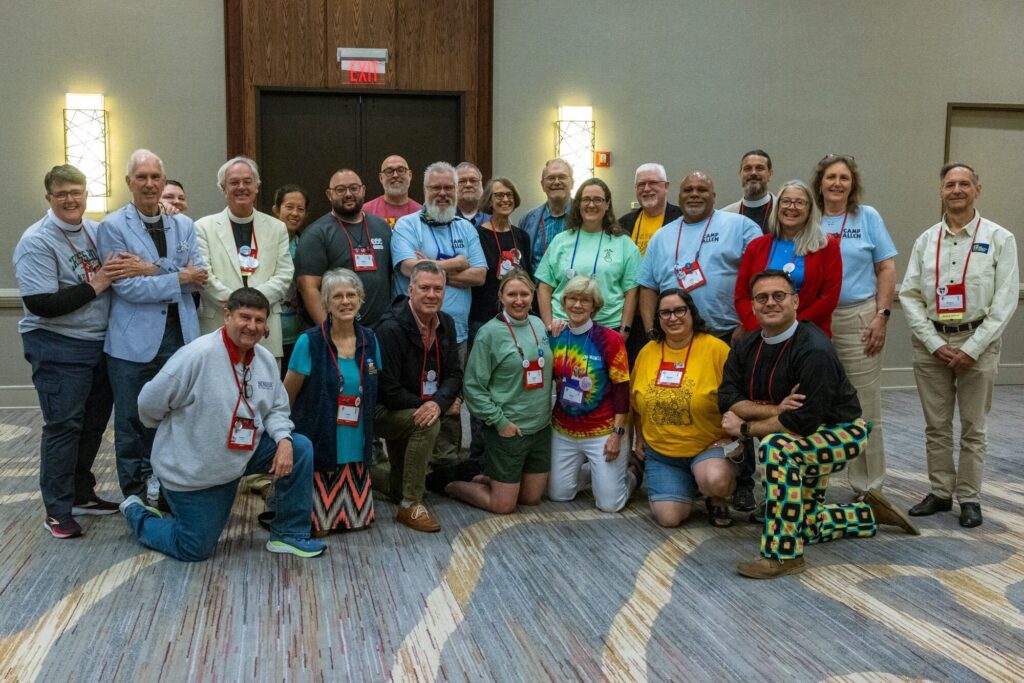
Deacon Stannard Baker had a good time chairing the House of Deputies Committee on Prayer Book, Liturgy and Music at the recently concluded General Convention of the Episcopal Church. That’s not always the case for the person who leads the committee, which, in recent decades, has handled some of the most controversial questions facing the Episcopal Church— questions such as whether to authorize rites for the marriage of same-sex couples, whether God must be referred to as “he” and whether to revise the Book of Common Prayer.
“It was an honor,” Baker said. “And I actually thoroughly enjoyed it. I had a terrific committee, very skilled, thoughtful, Spirit-filled and sprinkled with enough humor to make it a pleasure to do our work.”
It wasn’t that the committee wasn’t assigned a great deal of work. It dealt with 44 resolutions, including two that at previous conventions would have provoked impassioned debate: whether to put marriage rites for same-sex couples in the Book of Common Prayer, and whether to redefine marriage as between “two people,” rather than “a man and a woman,” in the church’s catechism.
Since both resolutions involve revisions of the Book of Common Prayer, both require passage at two successive General Conventions, and this was the first reading for each. Proposing the resolutions was a moment of particular personal importance for Baker.
He was the named plaintiff in Baker v. Vermont, one of the first judicial rulings in the United States to establish a right for same-sex unions, and he has been among the more visible leaders of the campaign for equal marriage in the Episcopal Church.
“I knew, even before presenting the marriage resolutions, that it would be an emotional moment for me,” he says. “Of course, I didn’t know quite how that would manifest in the actual moment.”
He imagined presenting the resolutions with his vice-chair, the Rev. Ruth Meyers, “long-time shepherding mother of the same sex marriage movement and rites in the Episcopal Church.” But Meyers had tested positive for COVID.
“Once I was on the platform podium, sitting and waiting as people testified, I started to well-up with emotion, and the tears came,” he says. In Meyers’ absence, he had asked Deputy Cynthia Black [of Newark, another leader in the marriage equality movement] to join him on the podium. “As we stood there, arms around each other’s backs, the tears came. They were tears of joy and relief — tears given to me by the grace of the Holy Spirit.”
Efforts to include same-sex marriage rites in the Book of Common Prayer had been frustrated at the two most recent two General Conventions, but this time, remarkably, they passed overwhelmingly and with little debate, an outcome made possible by accommodations arranged through other resolutions for conservatives who believe such marriages are not valid. The resolution on changing the catechism passed overwhelmingly as well.
But the emotional moments were not at an end. Baker also presented Resolution C032, which expressed the Episcopal Church’s remorse for the “irreparable harm” done by indigenous boarding schools, some of which were staffed, administered or sponsored by the church. The resolution directed the Standing Commission on Liturgy and Music, in consultation with Indigenous communities in the church, to determine an appropriate date on the church calendar to commemorate the Indigenous children who were forced to attend these boarding schools.
The resolution contained A Prayer to Remember the Innocents, which was read aloud by three Indigenous deputies after the resolution had passed.
“Their story is so poignant and horrible and they are so resilient,” Baker said.
Baker’s committee also took on more typical legislative tasks, such as authorizing a new expansive language version of Eucharistic Prayer C; approving alternative texts for the Good Friday liturgy in response to perceptions that the current texts are antisemitic; and establishing feast days on the church calendar for Harriet Tubman, Bishop Barbara Harris and the Philadelphia 11.
“I have to say that, despite having to begin at 7 a.m., I thoroughly enjoyed being on the committee and chairing it,” Baker says.
It was unusual that he found himself chairing the prayer book committee, because a deacon almost never holds that position. In another sign of his stature in the church, Baker was also elected to the church’s Executive Council.
“I was very moved by that and I’m feeling very humble and also kind of excited about it,” he says, noting that he would be the only deacon on the council.
“Deacons, we’re ordained to be servant leaders,” Baker says. “Often folks focus more on the servant part than on the leader part. Sometimes that keeps deacons from realizing their own sense of authority,” he says.
Baker credits his Quaker upbringing with instilling in him “a balanced response to authority.” He understands and respects the vertical organization of the Episcopal Church, he says, but feels that everyone, no matter their place in that hierarchy, has things to teach and things to learn.
“It’s my experience that some cradle Episcopalians — and others — are ‘authority bound,’ feeling they have no agency when dealing with bishops and priests, and — as a result — sometimes resenting their feeling of loss of agency. My sense is that I am not bound by that sense of ‘less than.’”
image: The House of Deputies and House of Bishops Committees on Prayer Book, Liturgy and Music at the 81st General Convention. Deacon Stannard Baker is standing at left wearing a blue blazer.