
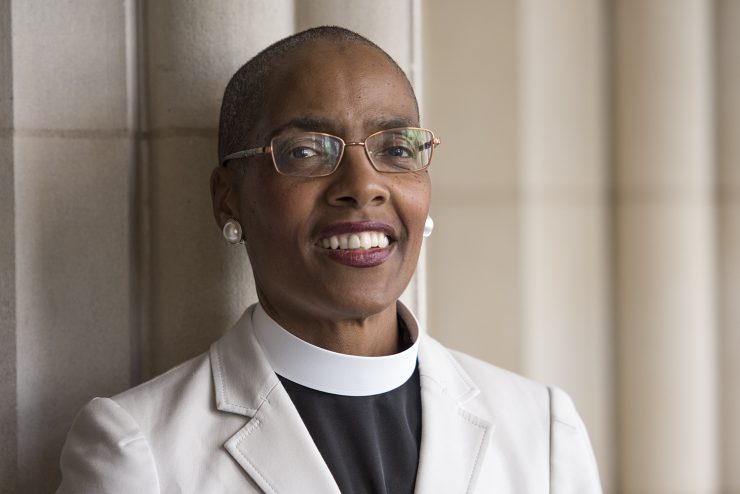
The Rev. Canon Kelly Brown Douglas is coming to the Cathedral of St. Paul in Burlington on Saturday, November 9 to deliver the keynote address at the in-person portion of this year’s diocesan convention, but her reputation precedes her.
Douglas is canon theologian at Washington National Cathedral, the former dean of Episcopal Divinity School at Union Theological Seminary, winner of the prestigious Grawemeyer Award in religion, and author of numerous books including “Stand Your Ground: Black Bodies and the Justice of God” and “Resurrection Hope: A Future Where Black Lives Matter.”
And she’s already at work on her presentation.
“In my time, I want to talk about what it means to expand our moral imaginary,” she says, “our sense of the possibilities that God calls us to, which are always beyond that which we can simply imagine.”
She begins from a simple premise. “It’s important, especially in these times, that we start to be church,” she says. “There is a difference between being a social institution that happens to be religious and being church, and there is a difference between what it means to be accountable to thriving and surviving as a social institution and being accountable to what God calls us to do as church.”
The in-person, fellowship and education-focused portion of the convention occurs only four days after the presidential election. The nation may well be uneasy, Douglas says, and churches bear some responsibility for speaking into this “unsettling and polarizing time.”
“The church has to have a role in holding our nation together, and to me that always begins by emphasizing the more—that is, it is about more than a saving our democracy, it is about saving our humanity,” Douglas says. “Our very humanity is at stake, and I think the church has to have a definitive role. It has to be in the public square in a different way. It has to call us back to who we were created to be as sacred creatures respecting the sacred dignity of each and every person.”
When churches abandon that role for fear of seeming divisive, Douglas says, the consequences can be significant. “We are not without responsibility when it comes to white Christian nationalism becoming such a prevailing social, cultural if not political narrative,” she says. “It couldn’t happen if there wasn’t a vacuum for that to land in, so now we’re playing catch up instead of leading the way to God’s just future.”
And, she adds, “All of that is going to be in the air at this convention.”
The difficulties the diocese encountered during and after the recent reorganization of its governance through the THRIVE process, are also in the air, Douglas says, and some of that tension finds its roots in the congregationalist culture that grew from the first English settlers desire to avoid the polity of what they perceived to be “the imperialistic Anglican Church.” But if this culture is in tension with the more centralized polity of the Episcopal Church, it features its own considerable strengths, she says.
“What we need to do is broaden our sense of community as koinonia (a spiritual community based on shared commitments),” Douglas says. “We build on that because people do know what community looks like, they do know what it means to be affirmed and accepted as part of the community, even as they know what it feels like to be marginalized or excluded from a community.” Faithful people should become accustomed to living amidst tension. Because the church, Douglas says, “has significant and primary responsibility in moving us beyond what we think is possible to what is really possible in terms of what God calls us to.”