
Dear Friends in the Diocese of Vermont,
As we live through a period with high market volatility, we understand that many of us are anxious about the status of our various endowment and retirement accounts.
For those of you who have deposited your funds in the Diocesan Unit Trust (DUT), we would like to affirm that our investment managers are staying the course, and are planning for the long term health of the DUT.
This fund is invested for the long term, and we do not make short-term changes when the markets fluctuate. We invest in the best companies with the best business models.
Specifically, our investment strategy takes advantage of the general upward trajectory of the stock markets when viewed over years rather than days or weeks. The portfolio is managed to ensure for sufficient cash, bond maturity and other fixed income instruments as well as ensuring there is adequate cash on hand to pay the 5% per annum dividends (paid out quarterly at 1.25%) that you receive.
That quarterly dividend is calculated as the average of the preceding 12 quarters to ensure there will not be sudden fluctuations in the amounts paid to you. And so that you may plan your operating budgets confidently.
The principal of the DUT has continued to rise steadily in spite of the 5% per annum (and other) withdrawals due to the excellent investment management of Michael McCormack and his team at Hickock and Boardman Capital Management.
A letter from Michael McCormack, dated April 9, and informational resources from Hickock and Boardman are available below.
If you have questions about your funds deposited in the DUT, please reach out to Ann Guillot, who chairs the Investment Committee, at annguillot@gmail.com.
We welcome your questions, any at all, and look forward to hearing from you.
Sincerely,
Ann Guillot, chair, Trustees of the Diocese Investment Committee
Sarah Cowan, president, Trustees of the Diocese
A Letter from Michael McCormack
April 9, 2025
Good morning,
The global equity markets have reacted sharply since sweeping global tariffs were announced April 2 by US President Donald Trump. The March pullback, which happened in anticipation, priced in a tariff package of roughly $300 billion, while the announced plan represented roughly double that amount.
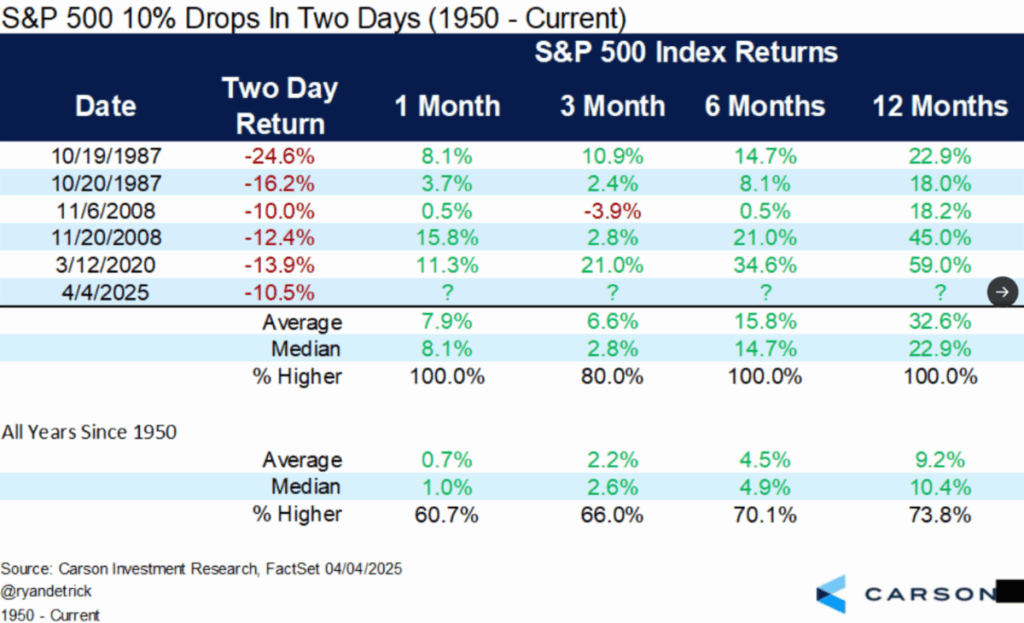
As a result, the days since the April 2 announcement have been especially volatile for the markets. Of course, telling you that volatility is a natural part of investing may not make it any less uncomfortable while it’s happening. The current events are not something that we have seen in our careers and likely something you have not seen either. It seems impossible to determine what the right answer is. In our practice at times like these, we instead look for what is reasonable. We have guided clients through volatile periods which always seem unique and make you feel ‘well, this time is different’. Whether it was 9-11, the credit crisis of 2008 and 2009, the pandemic of 2020 or all the other less impactful selloffs in the past, there is one clear answer, and you know what it is: Rebalance and stay the course even though it does not feel good. In some cases, it is reasonable to reduce risk or to reduce spending, or to raise cash levels. In most cases, it is most reasonable to remain invested and committed to the long-term asset allocation strategy. Over time, that strategy, while reasonable, often becomes right. In support of that point, I have attached to this email several interesting pieces which all point to how volatility plays out over time.
I am here to provide you not only with insight but with advice on how I can help manage the effects of – and potentially capitalize on – the markets’ movements. I am watching the markets closely but, in the meantime, please feel free to get in touch if you’d like additional perspective or guidance.
As always, thank you for the trust you place in me and our team.
Sincerely,
Michael McCormack
Remaining Calm Amidst Sell Offs
On Markets
Investing for Long Term