
The official purpose of the ribbon-cutting ceremony on Rock Point Commons on September 9 is to celebrate the transformation of two former conference center buildings into the new home of the Burlington School District’s alternative education programs for high school students. But it will also be an opportunity for Kelly Kimball, executive director of Rock Point Commons, to take a deep breath.
Since 1855, the 130 publicly accessible and painstakingly preserved acres that jut into the waters of Lake Champlain have held a special place in the imagination and operations of the Diocese of Vermont. Rock Point is the home of the diocese’s offices, the bishop’s residence, and Rock Point School, a small, alternative boarding school. And it is a landscape of great natural beauty.
But in recent years, the cost of tending the property had become unsustainable, and in November 2022, when she assumed her current role, Kimball also assumed the challenge of returning the property to a firm financial footing without undermining the Rock Point community’s commitment to four principal priorities: fostering learning opportunities for diverse communities; protecting Rock Point’s rich ecosystem; maintaining Rock Point as a place for spiritual refreshment through the beauty of nature; and providing space for small-scale agricultural projects.
“It became clear to me we needed a strong anchor partner,” Kimball says. “We weren’t going to be able to do this ourselves. It felt urgent to figure out a pathway to sustainability.”
“Discerning a sustainable vision for Rock Point Commons has been a critical component of our work to put the entire diocese on firm financial footing,” Bishop Shannon MacVean-Brown, who chairs the Rock Point Commons Board. “Kelly’s clear vision and dedicated leadership has been invaluable for Rock Point, and therefore for our entire diocese.”
Within her first few months, Kimball sent letters to 66 organizations and 130 individuals seeking potential partners. The response was almost non-existent. But there was one organization on the list that already had a small, temporary presence on Rock Point, and as it turned out, was interested in a more significant relationship.
In the fall of 2020, just as students in much of the country were preparing to return to classrooms after an early-pandemic hiatus, the Burlington School District learned it would have to close its high school and technical center after high levels of PCBs were found in the air. Bobby Riley, principal of the district’s high school alternative programs, knew that another stretch of remote learning would be unhelpful for students in OnTop, an alternative educational program for high school students, and he worked with Paul Habersang, Kimball’s predecessor, to secure space for OnTop in the Rock Point Commons conference center buildings, which were unoccupied due to the pandemic.
The change made an immediate difference in students’ lives. “The place just feels like a nurturing environment,” Riley says. “There was almost like an exhale we could sense. It made a difference; it really did.”
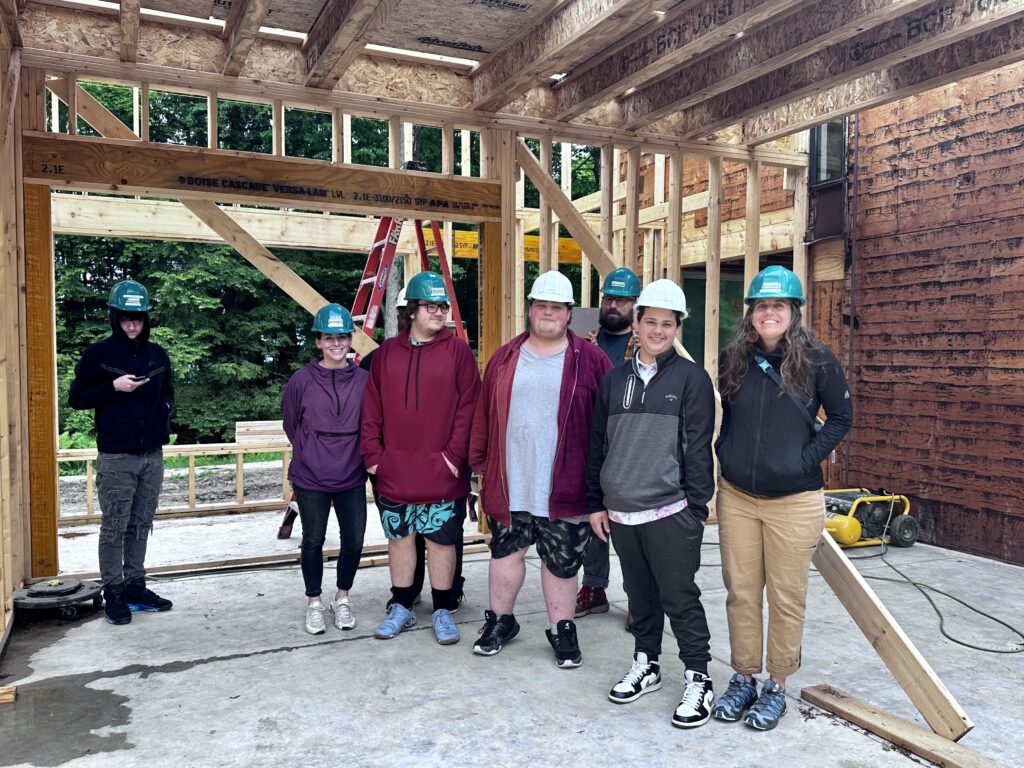
The success of the arrangement led to tentative conversations with Habersang about whether the school district could also locate Horizons, its other alternative education program, on the Rock Point Commons campus. Hosting both programs would require a significant commitment from both parties. Rock Point would need to commit conference center buildings — Butterfield, which included the center’s a dining room and kitchen, and Van Dyck, which, for years, had provided dormitory rooms for overnight lodging to a dwindling clientele — to the school district during school hours. It would also have to permit modest construction that would link the two buildings, create a two-classroom addition and include an elevator to make the facilities accessible to those who could not climb stairs.
The school district would have to pay for the construction and improvements — $4.5 million proposition — sign a 15-year lease (with options for two additional 15-year terms) and abide by stringent environmental policies.
“I felt the weight of a decision that is going to have implications forever, really,” Kimball says. Butterfield and VanDyck can still be used for conferences when students are not present. Still, Kimball says: “It’s a permanent change and not just to how the buildings are used and to the presence on the land.”
The Rock Point Commons Board of Directors felt a similar responsibility. “There was interest and curiosity about the financial stability part of this, but it was very clear this was a mission-driven organization, and that our decision would not be based solely on money,” Kimball says.
The same thinking prevailed among the Trustees of the Diocese, which received the school district’s proposal after the Rock Point board had approved it.
“From my perspective as a trustee, when we learned the school district wanted to establish this long-term partnership, I set out saying this would be a great way to stabilize and enhance the financial sustainability of Rock Point,” says Sarah Cowan, president of the trustees.
“That said, I also felt that this type of a partnership had to be done in a way that 20 years from now, or 50 years from now, we members of the Diocese of Vermont don’t look back on this and say, ‘We didn’t do it right,’” she says. “So in my mind as a trustee, I felt it was critical we move forward on this in a way that preserved everything from the spiritual nature of Rock Point to the financial stability of the diocese and also the aspect that this is welcoming and open to a much larger community beyond just us with in the diocese.”
One concern the Rock Point Commons Board and the diocesan trustees shared was the welfare of Rock Point School, a non-traditional private boarding school that has been operating on the point for 95 years. But C. J. Spirito, the head of school and a vice president of the Rock Point Commons Board, was excited about the project.
“The opportunity for the diocese and Rock Point School to work in tandem with the school district seems like a really positive fit,” he says. “It made sense mission-wise and it made sense financially, so we have supported it from the get-go. It is important to us to work collaboratively, while simultaneously maintaining our own identity, which is very possible to do together.”
In the end, the trustees, like the Rock Point Commons Board, approved the plan because it advanced the diocese’s mission and embodied the values that have long guided the uses of the point.
“We talk a lot about the ‘nature equity gap,’ Kimball says, “and we’re aware that there are people who have less access to beautiful, natural spaces. This relationship gives us an opportunity to advance our diversity, equity and inclusion goals, and to expand our connection with local schools and kids.”
Kimball says Rock Point’s leaders were impressed and gratified by the school district’s enthusiasm for the project, especially its willingness to meet the environmental standards that prevail on Rock Point. “I feel like they share our sense that this place is really special,” Kimball says. “We gave them so many hoops they had to jump through in terms of environmental stuff, and they contracted to do it.” Those hoops included no single-use plastics, mandatory composting and the requirement that students be bussed to Rock Point to avoid drop-off and pick-up lines.
Riley says the school district was simply eager for the partnership. “We have a population of student who typically have a bad experience with school for a variety of reasons,” he says. “A new environment, a beautiful setting, can say a lot about your experience with school. My hope is they start creating a new narrative about what school can be for them. I am exciting about that and think students will be too. I have a great deal of appreciation and gratitude to the school district and Rock Point Commons for undertaking this project.”
Construction work in the conference center buildings is on schedule, which is fortunate, because the first day of classes for the alternative programs is August 26.
photo by Kelly Kimball: Burlington School District students tour construction of new facilities on Rock Point on May 29 with Rock Point Commons board member Alexa Visco (far right).