
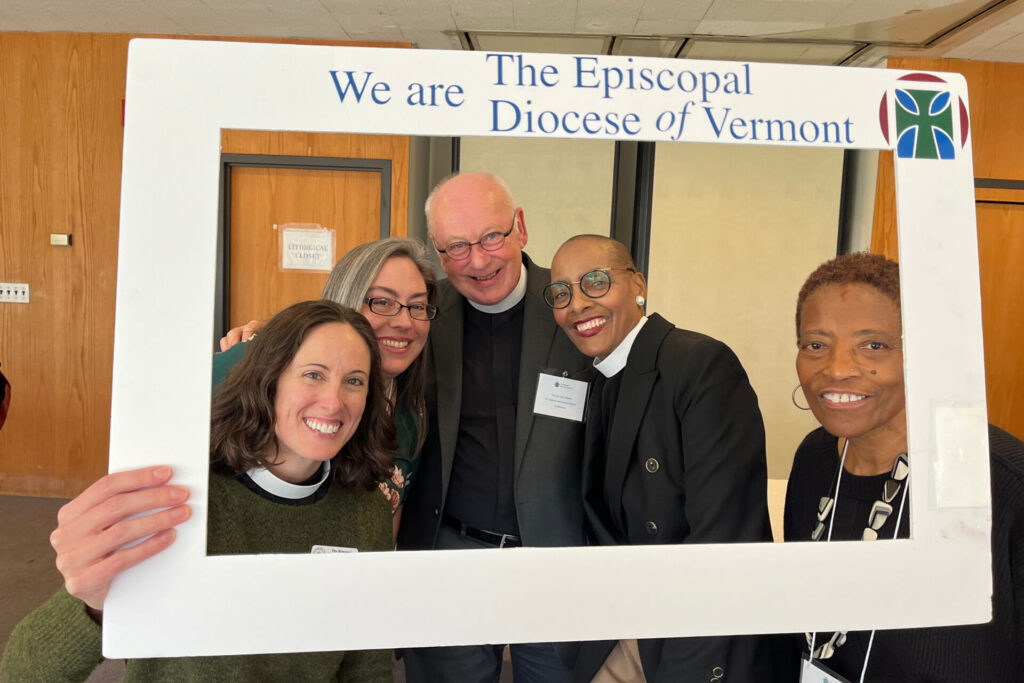
Gathering at the Cathedral Church of St. Paul in Burlington in the wake of the presidential election, more than 150 delegates and visitors to the in-person portion of the Diocese of Vermont’s annual convention spent the day considering what it means to be church at this time.
The Rev. Canon Dr. Kelly Brown Douglas, keynote speaker, began her address by noting, “we come together on this day, four days after what for some has been an unsettling election season, asking the question, ‘what does it mean to be church?’”
During her convention sermon, Bishop Shannon said, “We have seen the realities of a house divided against itself … though we were founded as a nation in which church and state would be separate, how we live through these strains in civic society have direct bearing on how we live as people of faith.”
Douglas, canon theologian at Washington National Cathedral, and visiting professor at Harvard Divinity School, said the church must foster a “just peace,” and to do this, it must “rethink Christian mission.”
Historically, she reminded the convention, “mission” has been associated with “converting people.” This understanding of mission, she said, “essentially made victims of those who were to be converted,” and its violent legacy can be seen today in the white Christian nationalist movement in the United States.
Douglas called for the church to instead embrace a “liberative paradigm of mission … defined by freeing people from whatever it is that prevents them from living into the just future that God promises and desires for God’s world and for God’s people.”
Congregations seeking to put a liberative gospel mission into practice will not “land upon a people,” but instead listen and learn “from those on the underside of justice,” before taking action. “How often is it that we, good Christians as we are, go into situations assuming what is best for those who suffer and what it is that they need,” she said.
Putting a liberative model into practice also requires engaging in politics, Douglas said. “While we are not called to be politically partisan, to spread the good news of the gospel is to be partisan when it comes to the values of God,” she said.
Christians’ model for this kind of partisanship is Jesus, who “did not endorse any particular political or religious party of his day,” but was political in the way he carried out the gospel values in his ministry, Douglas said.
“At the same time,” she continued, “Jesus stood firmly against those principalities and powers which were an affront to the dignity of every human being, and thus an affront to the kingdom of God.”
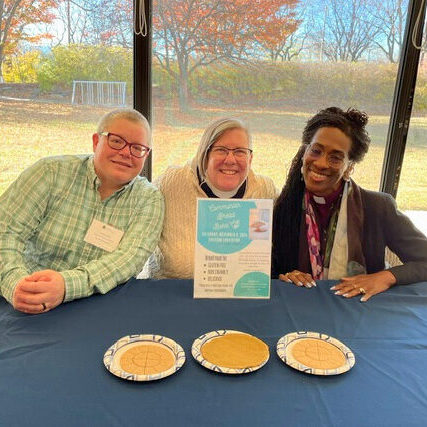
In between Douglas’ keynote, and Bishop Shannon’s sermon, delegates and visitors watched as judges, Bishop Shannon, Dean Greta Getlein and Margaret Schotto, diocesan manager for operations, declared that a communion loaf baked by a member of the Constellation of Grace Church, Sheldon & St. Luke’s, St. Albans had won the communion bread bake-off over two other entries.
In her homily, the bishop spoke about the ministry of the Rev. Dr. Martin Luther King Jr., whose embrace of koinonia — being and building beloved community, captured in a passage from the Acts of the Apostles that was read at the liturgy — inspired this kind of liberative, political engagement in the name of just peace.
King believed in the promise of God’s justice, Bishop Shannon said. And he “insisted that our faith compels us to work together, pray together, act together, advocate together, learn together, celebrate together, and non-violently use our power together to create political policies that affirm the dignity of every person, and that this is enacted by every person having what they need to live full and productive lives.”
Bishop Shannon recalled that participants in September’s Diocesan Household meeting heard the same passage from Acts. “That time together was held within the context of concern for the looming election,” she said. As the group considered the challenges facing the church and the world today, participants expressed a longing, not for the past, but for the “spirit of the early church,” which was “to be and build beloved community.”
“In this time of societal upheaval and a desire for stability and flourishing in our diocese, I was inspired and lifted by your dreaming; you gave me hope for our church and for the world,” she said.
And so inspired, Bishop Shannon called those present to go out from the convention to “be the church” at this time by adopting “a spirit of koinonia,” as modeled by King and the early church, concluding with three questions:
Will you acknowledge Jesus by committing to develop a spirit of koinonia?
Will you acknowledge Jesus by dreaming dreams of being and building beloved community?
Will you acknowledge Jesus by abandoning yourself to the growth that God is completing in us and in the world?
The congregation instinctively responded to each question with the words, “I will, with God’s help.”